Sending Bulk SMSs

FYDO allows you to contact patients via SMS to assist in efficient workflow. These can be sent one at a time or to a whole list of patients. The system gives the ability to pre-populate the SMS with information regarding the admission/episode e.g., date of admission, time of admission, health fund excess amount etc

Use these instructions if you would like to send a Bulk SMS to a number of patients at once:

  1. Open the Appointments Screen & navigate to the required date & theatre
  2. Use the Actions dropdown on the right of the screen to select Send Bulk SMS


  3. Use the Template dropdown box to select from the preloaded SMS templates in your system (For help with customising these contact Altura Health or visit https://wiki.fydo.cloud/sms-templates/)
  4. Or free type in the Text box to customise the text message
  5. The Send with delay tick box allows the text to be scheduled for a later date & time. If this feature is being utilised enter the Date & Time that the text will be scheduled to send. However, there is no need to use this feature if the text is intended to be sent in real time
  6. All patients with a valid mobile phone number will be selected by default. Use the tick box at the top of the column to easily select or de-select all patients’ at once. Or use the tick box for each patient to individually select or de-select
  7. Use the drop-down boxes in the top right to assist in filtering to the desired patient demographics
  8. Confirmed gives information regarding previous SMSs sent. To assist in determining if they still require an SMS
  9. Cancelled gives information regarding the patients’ cancelled status. However, the screen opens to show Not Cancelled patients’ only. This column is only relevant if the filter has been set to include the cancelled patients’, using the drop-down boxes in #13
  10. The Excess column displays the amount that has been entered into the Excess field of the patients episode
  11. Once all relevant information has been completed, & all desired patients’ have been selected, click Send Bulk SMS
  12. You will be asked to confirm that you wish to send the SMS, click Yes
  13. The Credits Remaining on the account are displayed on the screen & once the credits get low use the Order more SMS credits option on this screen to be re-directed to the Order SMS Credits screen where you can follow the prompts
  14. Back to Appointments button returns the user to the appointments screen

Once the patient has been sent an SMS there will be a visual cue on the Appointments screen. The icon will change depending on the status of the SMS sent. The icons represent the following:

·    This icon will display once the SMS has been sent but not yet delivered to the recipient

·   This icon will display once the SMS has been delivered

·   This icon will display once the recipient has replied

Hover over each of these icons, in the appointments screen, to display the information that the SMS contained. Once a reply has been received it will also be displayed below the message.


Adding Other Services Codes (Hospital)

These instructions will assist users in Adding or amending an Other Service Code / Prosthesis Code for the purpose of updating the description or information related to the item.
Prostheses list updates will be automatically loaded into FYDO. Any new items will be added & all new fees will be imported. Descriptions will not be updated, as some facilities prefer their own descriptions & do not what them overridden.
  1. Go to Settings
  2. Scroll down to Hospital > Fees Management & select Other Services


  3. Use the Hospital Drop Down box to select the facility if it is a multi-location database
  4. Use the All Services Drop Down box to select a specific service type, if necessary
  5. Use the Search field to determine if the code is already in the system. The search fields can be used to search codes, descriptions or companies etc to allow the user to search any part of the other service information
  6. If the code appears, double click to display the information. If it doesn’t appear, use the Show Inactive tick box to be sure that the code isn’t in the system as Inactive
  7. If the code needs to be added, click Add Other Service
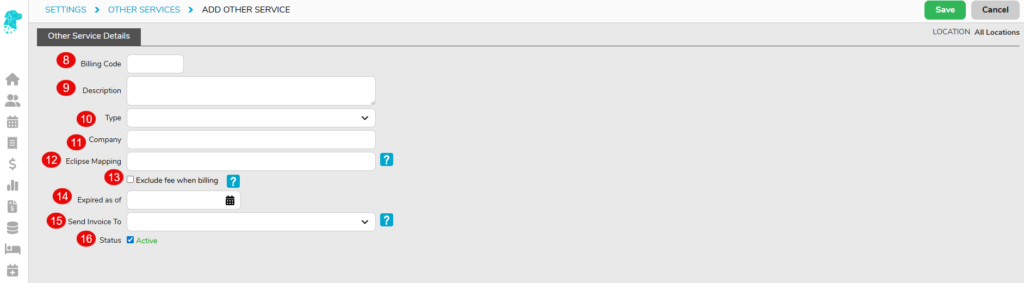

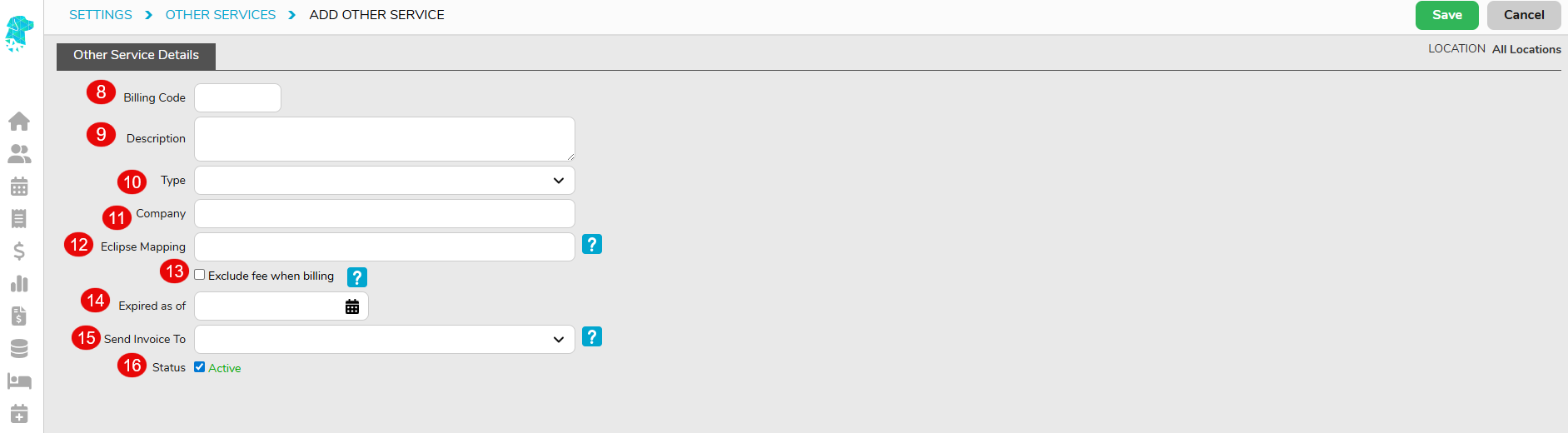
  8. Enter the Billing Code. (This is the only information that will not be editable once the item is saved)
  9. Enter the Description (Mandatory Field)
  10. Use the Type dropdown to categories the item:
    a. Allied Health Services
    b. Disposables
    c. Labour Ward
    d. Nursing Fee
    e. Other
    f. Pharmaceuticals
    g. Prostheses
    h. Theatre Fee
  11. Enter the Company that supplies the product. (This can assist with reporting on prosthesis etc, as the other services reports can be run by suppliers)
  12. Enter Eclipse Mapping if the Other Services code that is being entered requires a prefix before the code itself. (Only add the prefix to this field, not the prefix & the code)
  13. Use the Exclude fee when billing tick box if this Other Service is excluded from certain Casebase contracts. For example, if the contract lists an all-inclusive fee for a procedure, that also includes prosthesis, this tick box would ensure there is no fee raised for this particular prosthesis when billed in conjunction with the particular Casebase item. For this feature to work the tick box in the Casebase Fee Set up called Exclude Other Services also needs to be ticked. When these two tick boxes marry up there will be no charge raised for the other serviced when billed with that item. For any other Casebase or per diem fee, without this Exclude Other Services tick box marked, there will still be a fee raised for the other service
  14. If an Other Service item can no longer be used for billing/claiming, you can allocate an Expiry Date
    1. If the item should always be billed to the patient, you can set this as the default by selecting Patient in the Send Invoice To dropdown

    2. Use the Status to mark a code as Active or Inactive
    3. Once all desired information has been entered click Save
    4. The Export to Excel option allows for the other services, along with the fees for each fund, to be exported to an excel spreadsheet. Use the Search field to filter down to a particular company or description etc to export more specific data (e.g., Search Alcon to export a list of all prosthesis in the system with the company listed as Alcon)
    5. To Delete an item, use the cross in the Action column to delete. You will then be asked to confirm that you are sure you want to delete the other service.

    The Other Service / Prosthesis Code has now been added to your FYDO database.

    For information on how to add the associated fees to this new item please see instructions Adding Fees to Other Services Codes (Hospital).


    Sending Individual SMSs (Hospital)

    FYDO allows you to contact patients, and their pick up person, via SMS to assist in efficient workflow. These can be sent one at a time or to a whole list of patients. The system gives the ability to pre-populate the SMS with information regarding the admission/episode e.g., date of admission, time of admission, health fund excess amount etc

    Use these instructions if you would like to send an SMS to an Individual Patient or to the patients Pick Up Person:

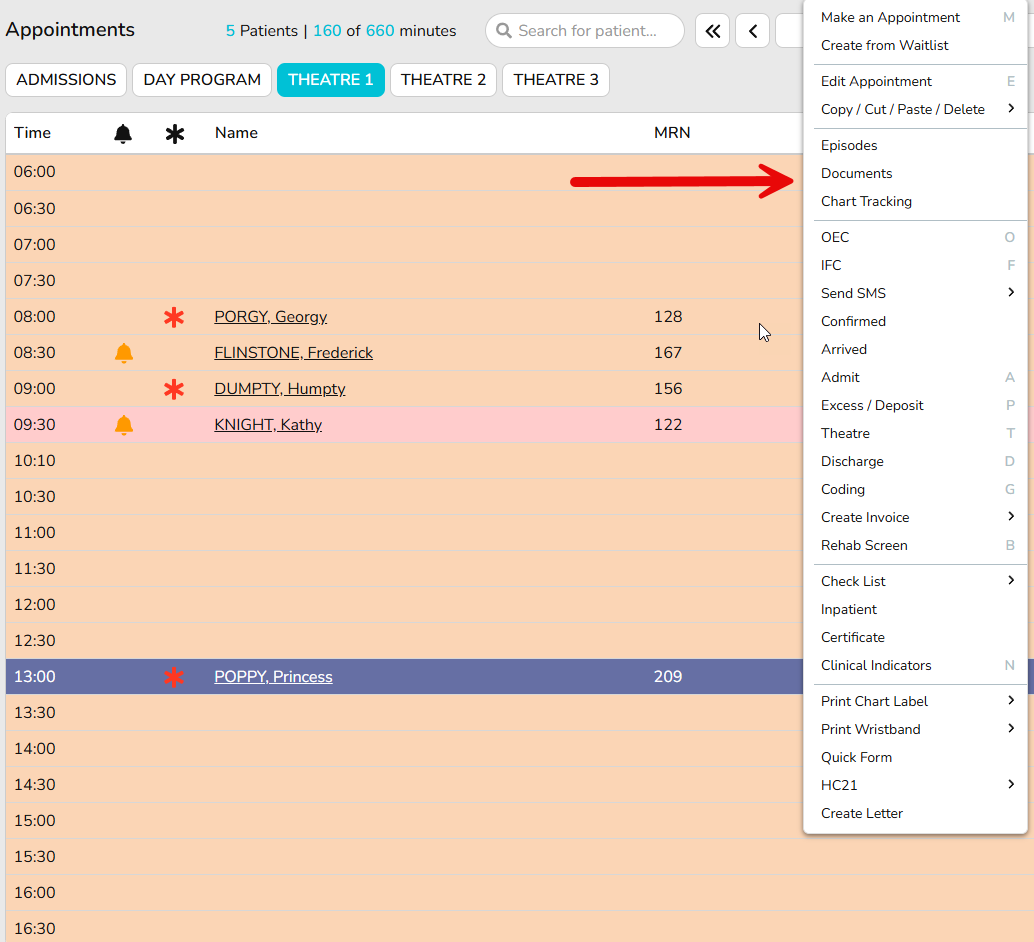
    1. Navigate to the Appointments Screen & locate the required episode
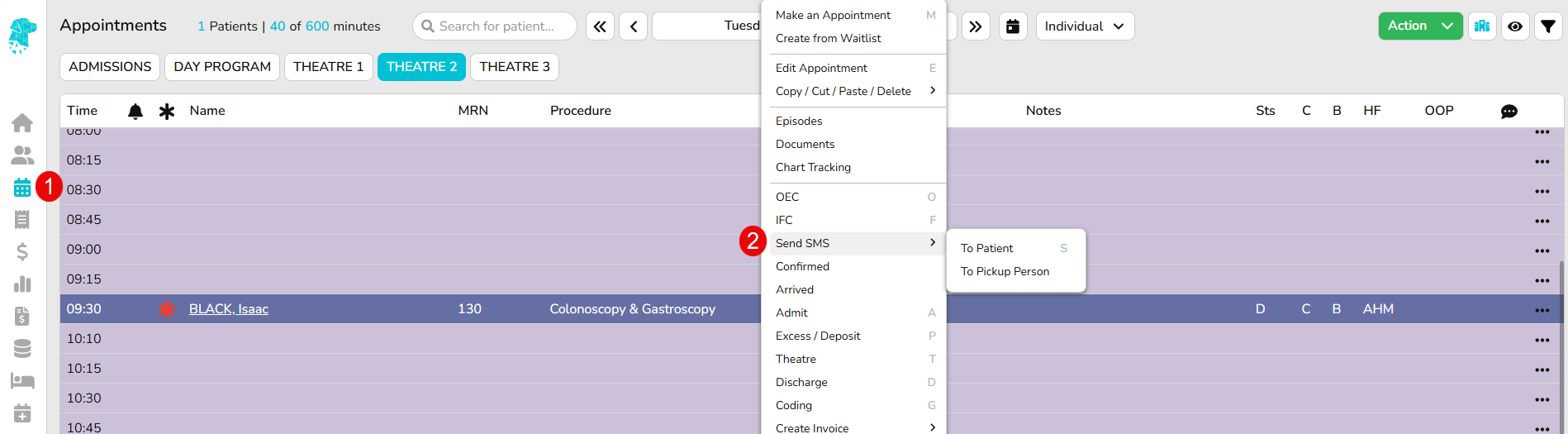
    2. Right-Click on the required episode & hover over Send SMS to show the 2 options to either Send SMS to the Patient or Send SMS to the pickup Person (Or use the shortcut key “S” after you have selected the required patient to send SMS to the patient)

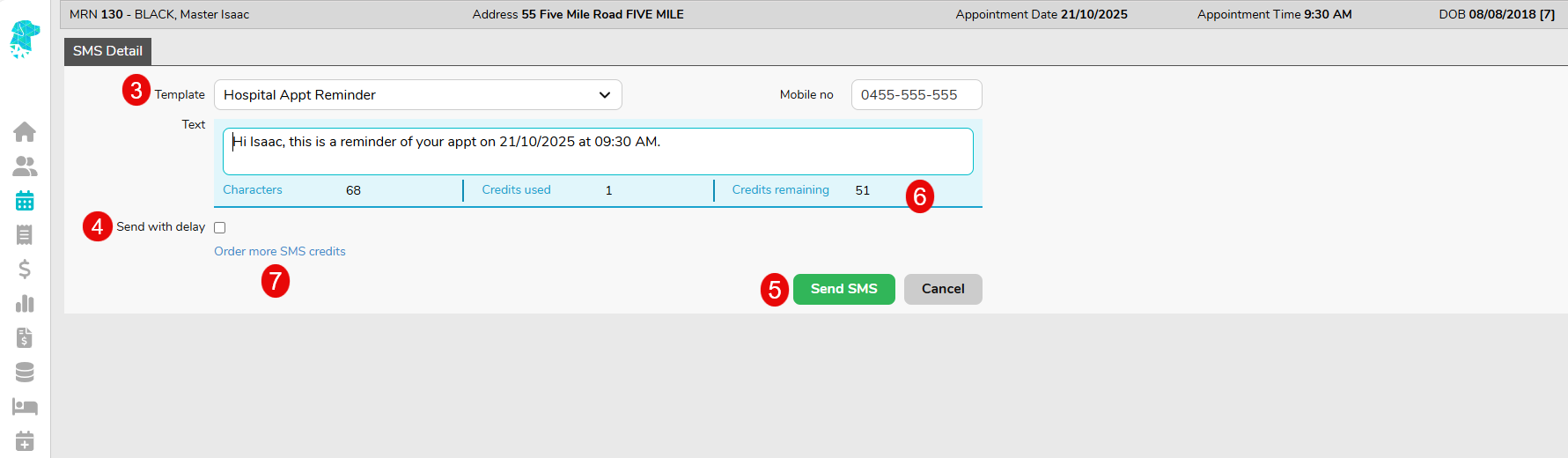
    1. Select the required Template or free type desired message in the Text box
    2. Use the Send with delay tick box if the message is required to be sent at a specified time, as opposed to at the current time. If you are wanting to use this option, select the Date & Time that the message is to be sent
    3. Once all details have been checked click Send SMS
    4. The information included in Blue explains:
      a. Characters – The current length of the text message. Each individual text message is allowed to be 160 characters long. Once the length exceeds this amount, it will require more credits to be sent
      b. Credits – This shows the number of credits that will be used to send the message, depending on the length of the text
      c. Credits remaining – Shows how many credits are remaining on your FYDO account
    5. Once the credits get low use the Order more SMS credits option on this screen to be re-directed to the Order SMS Credits screen where you can follow the prompts to purchase more credits

    Once the patient has been sent an SMS there will be a visual cue on the Appointments screen. The icon will change depending on the status of the SMS sent. The icons represent the following:

    ·    SMS has been sent but not yet delivered to the recipient

    ·   SMS has been delivered to the recipient

    ·   Recipient has replied to the SMS

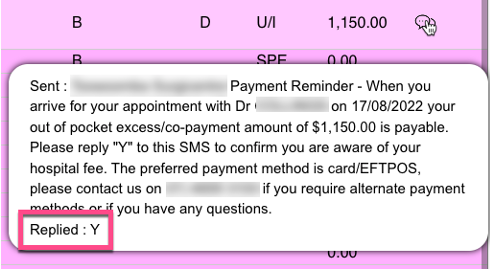
    Hover over each of these icons, in the appointments screen, to display the information that the SMS contained. Once a reply has been received it will also be displayed below the message.


    Emailing Documents from FYDO

    FYDO facilitates emailing of documents, that are stored in the Documents tab, to the patients, doctors & referring doctors.

    1. Navigate to the required patient, in the Patients tab and once the details are open select the Documents tab

    1. Alternatively, locate the required episode and use the Right Click menu to select Documents

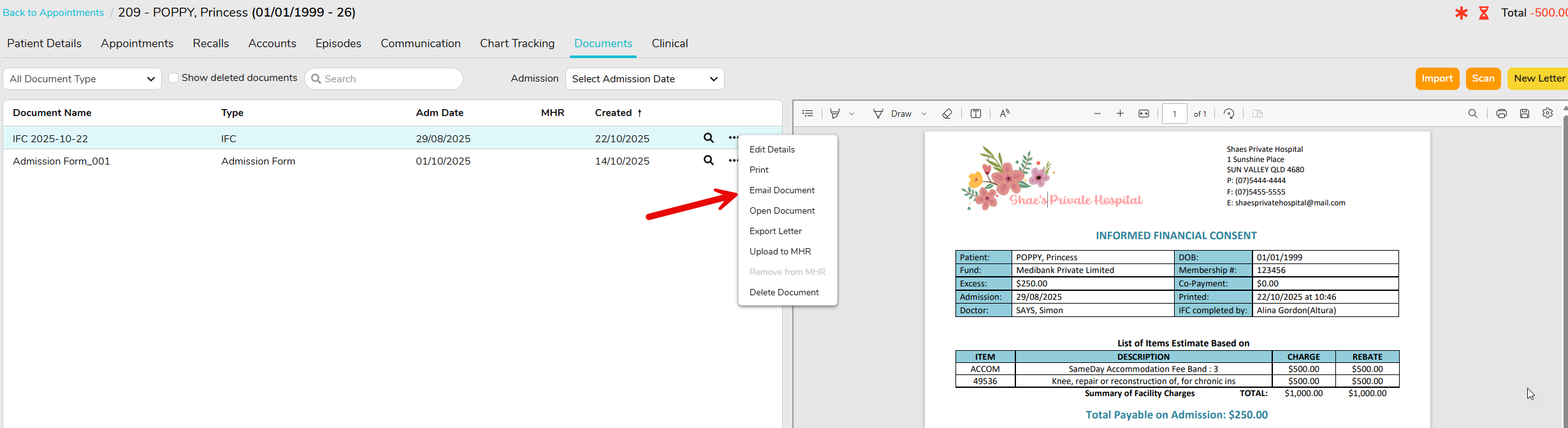
    1. Select the document that you wish to email & use the three black dots, on the right of the document, to display the menu options
    2. Select Email Document

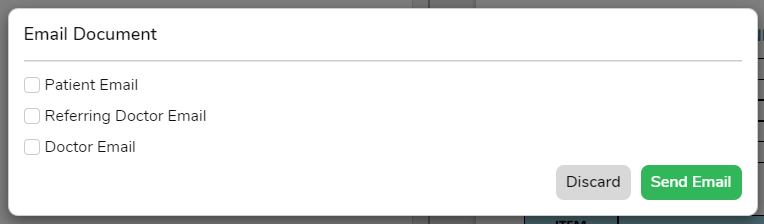
    1. The Email Document pop up box will be displayed & allow the user to choose who they want to email

      – Patient Email allows emails to be sent to the patient. The email address is automatically populated, from the Patient Screen, if it is entered
      – Referring Doctor Email allows emails to be sent to the referring doctor. The email address will automatically populate if the document is linked to a particular admission, that admission has a referring doctor listed & the referring doctor has an email address added in FYDO. (Referring Doctors emails can be added in Settings > Referring Doctors)
      – Doctor Email allows emails to be sent to the admitting doctor. The email address will automatically populate if the document is linked to a particular admission & the doctor has an email address added in FYDO. (Doctors emails can be added in Settings > Doctors)

      If no email address is on file, for any of the above options, the user can add the email manually into the relevant field

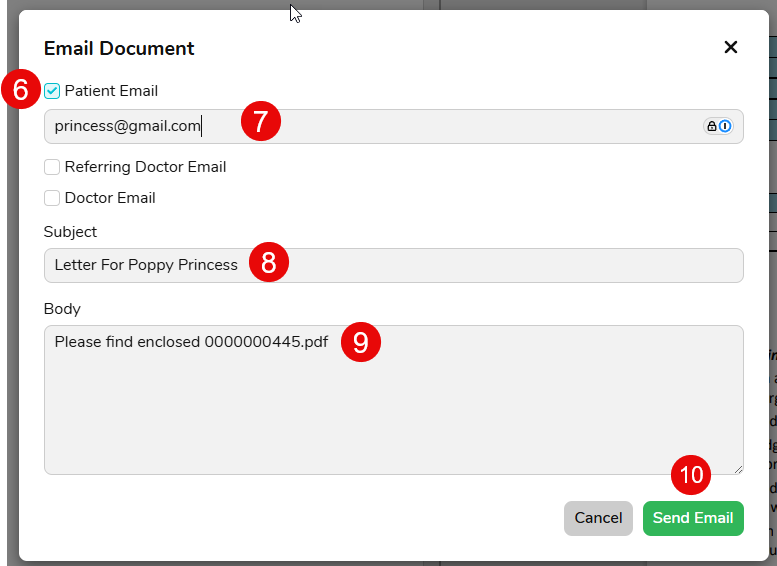
    1. Select who will be receiving the document via email by ticking the box to the left of their description
    2. Check the email address listed is correct, or manually type the email address
    3. Subject line will automatically populate however users are able to make changes if required
    4. Body of the email will automatically populate however users are able to make changes if required
    5. Once all fields have been complete, select Send Email
    6. A log of all emails sent can be found in the Communication tab, along with all SMS history


    Preadmit Hospital Portal – Back End User Management

    User Management gives the ability to add users, delete users & change their user permissions. Only the Hospital Admin has access to User Management

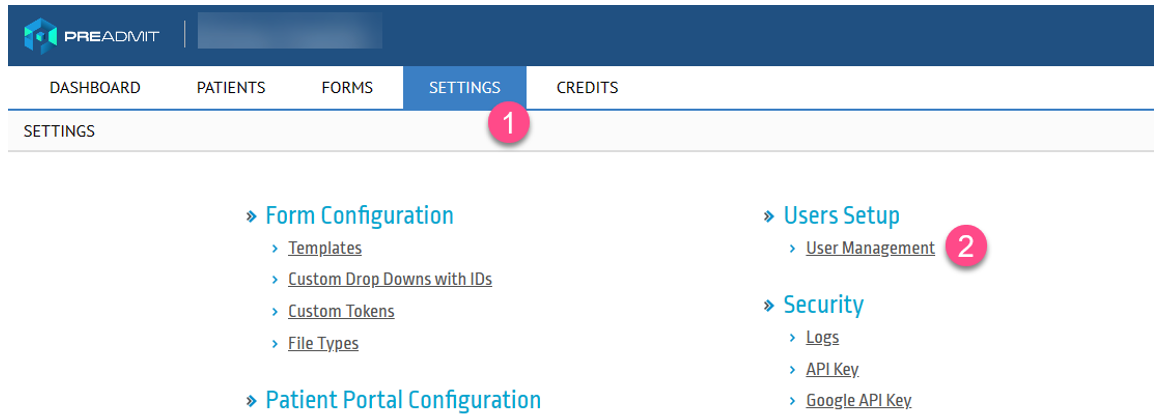
    1. Select the Settings tab
    2. Select User Management
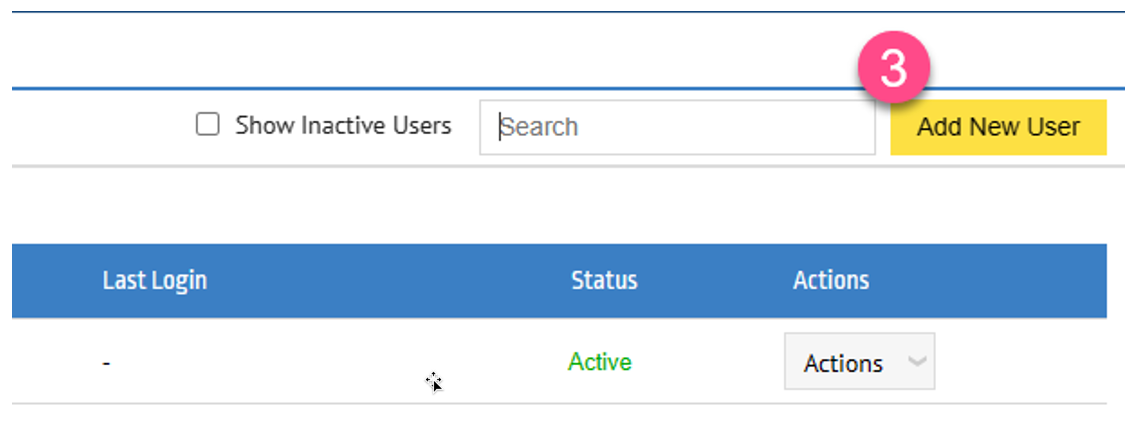
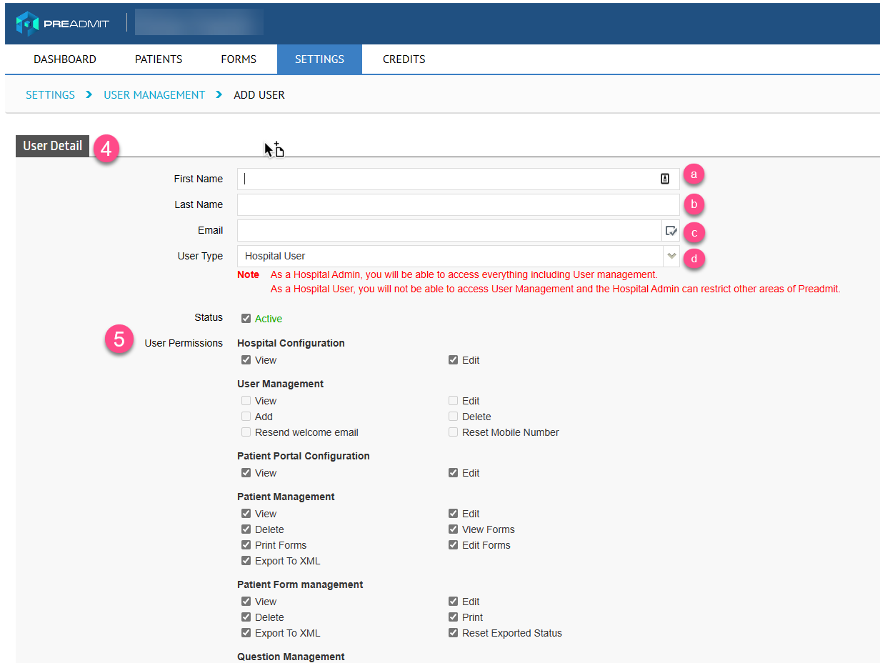
    3. To add a new user > click Add New User in the top right-hand corner.
    4. From there, enter all the details that are required.
      a. First Name
      b. Last Name
      c. Email Address
      d. User Type– Hospital Admin or Hospital User.
    5. Select the permissions that each user is required to have. This is customisable to each user and can only be changed by Hospital Admins.
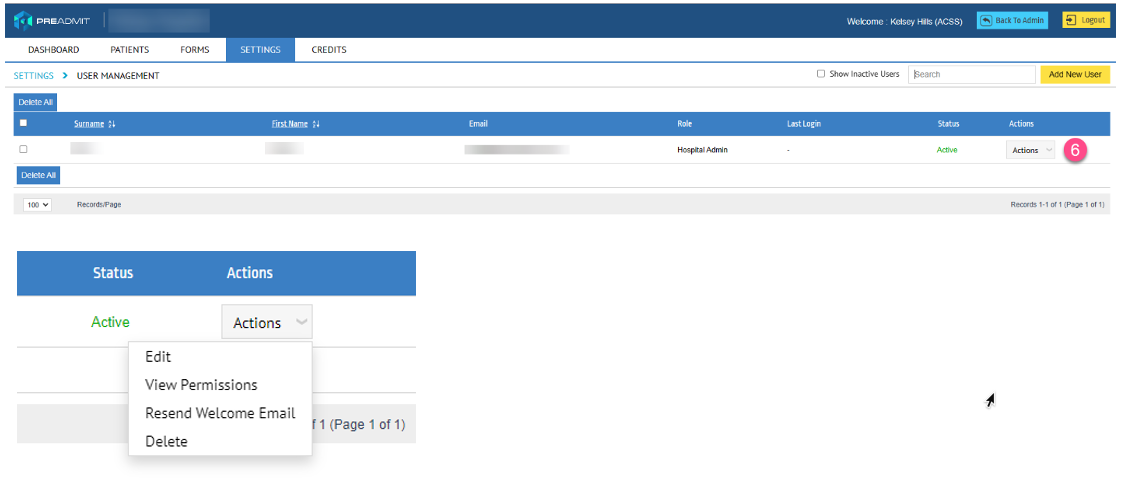
    6. To delete a user, edit their details, edit their permissions or resend their welcome email, use the Actions dropdown next to their name.


    Creating Custom Hospital Views in the Appointments Screen

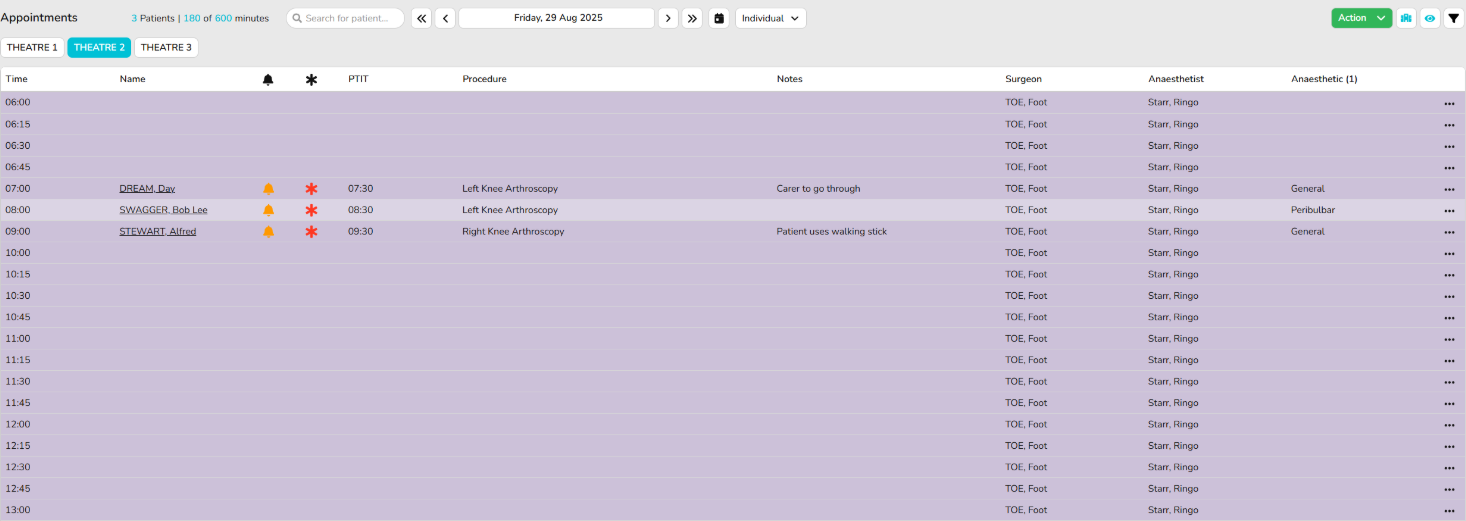
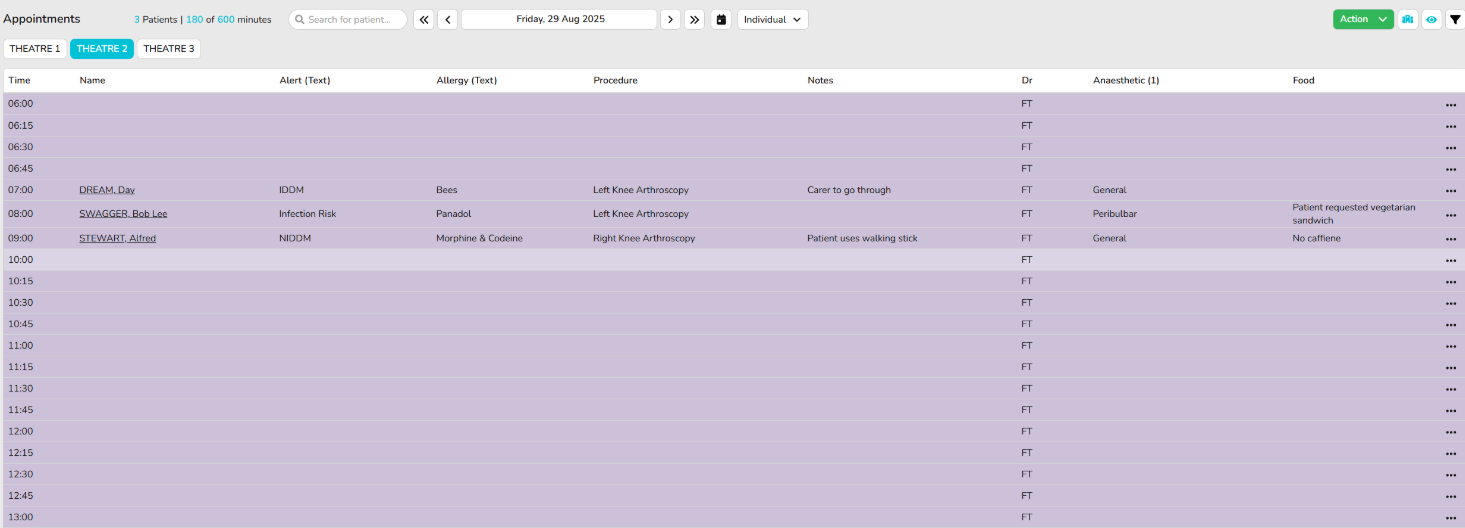
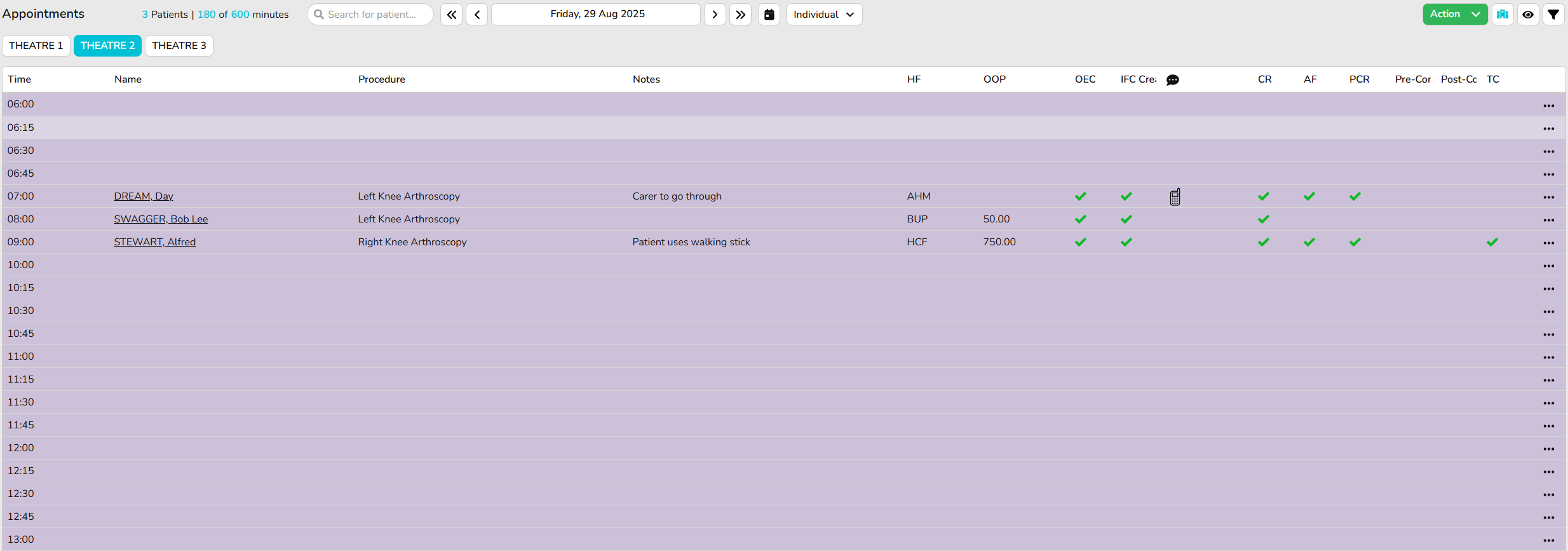
    The Appointments Screen in FYDO is completely customisable. Creating different views will assist in workflow & efficiency & allow different staff members to view information that is relevant to them.
    The views that are created are available to all users on the database & each user can choose their own favourite default view by selecting the heart next to their chosen view.
    Users are able to have a favourite custom view for each view type, eg. a favourite “Individual” view, a favourite “All” view & a favourite “Weekly” view.

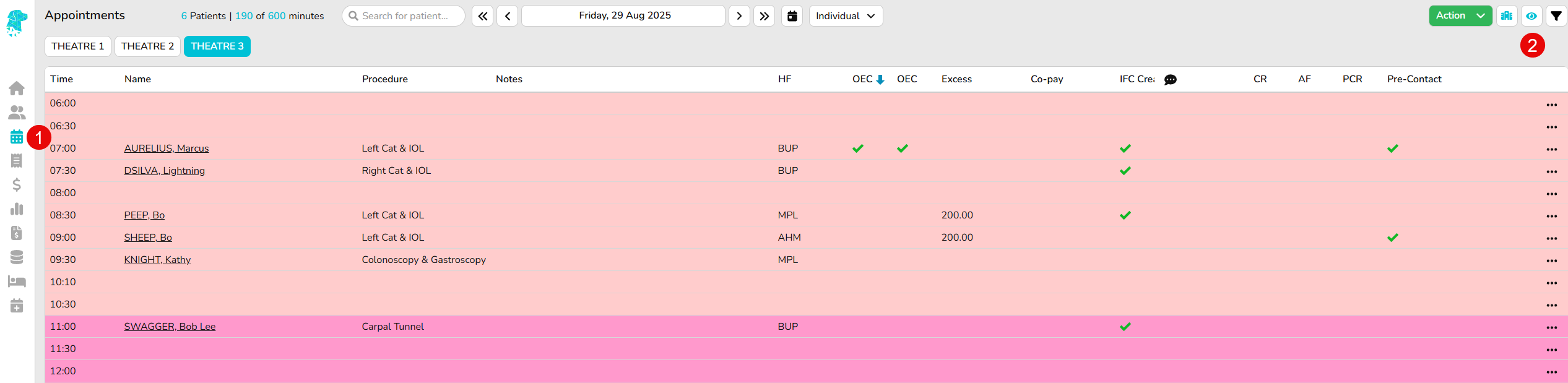
    1. Custom views are created in the Appointments Screen
    2. Hover over the eye icon & select Add New View

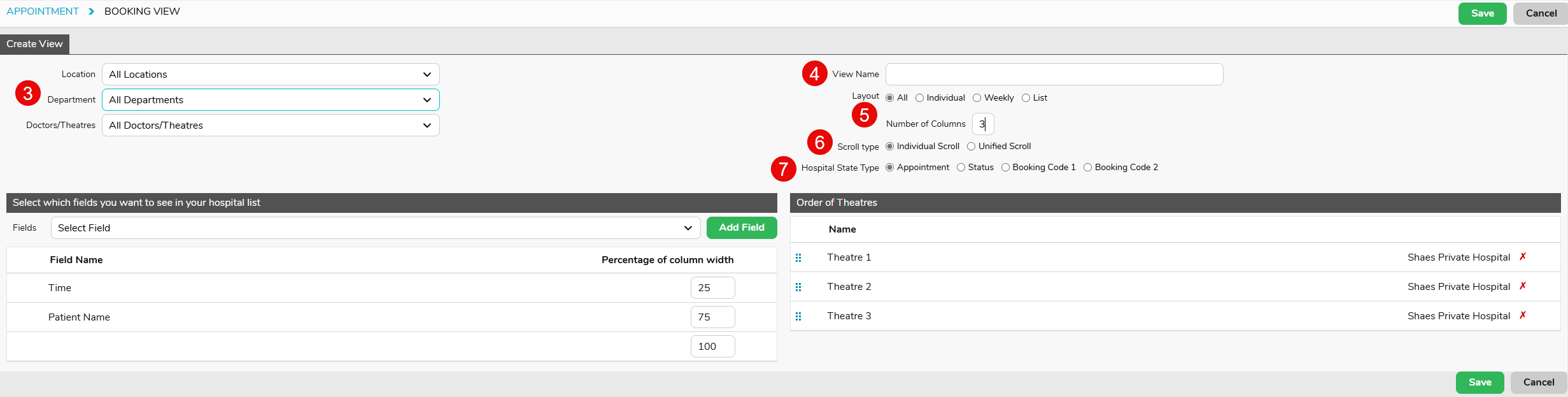
    1. Select the Location, Department & Doctors/Theatres that you want the view to be available for. Or leave with All selected for the view to be available all the time
    2. Add the View Name to identify the view that you are creating. E.g., Theatre, Recovery etc
    3. Choose the Layout in which you would like the view to open. E.g., Individual theatres, all theatres or weekly view
    4. Select the Scroll type based on how you would like to view the screen when you scroll.
      Individual Scroll– You will be required to hover over the theatre in which you would like to scroll up or down.
      Unified Scroll- This allows you to scroll anywhere on the page and all the theatres will scroll together
    5. Select the Hospital State Type. You have the option to set the appointments to display by:
      – Appointment Type- This will colour code the bookings as per the Appointment Type in the booking
      – Status- Will colour code the bookings according to where they are in the facility
      – Booking Code 1– will colour code the appointments according to the booking code 1 that has been entered
      – Booking Code 2- will colour code the appointments according to the booking code 2 that has been entered

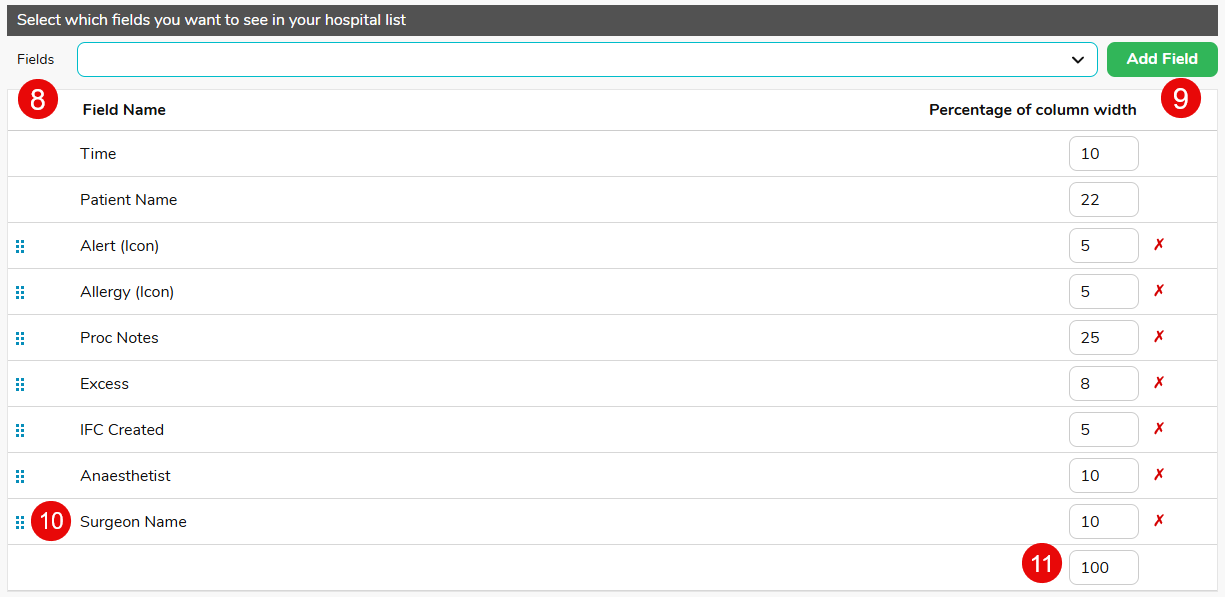
    1. Use the Fields dropdown to select the type of information that will be added to the custom view
    2. Click Add Field to add the selected field to the table below
    3. Use the on the left of each line to sort fields into the required order
    4. Use the Percentage of column width fields to determine the width of each column
      N.B. the total of these columns always has to add up to 100.
    5. Click Save and the appointment screen, with the new custom view that was created, will be displayed

    Some examples of helpful views are:

    Administration View
    Theatre View
    Recovery View


    Theatre Roster

    Creating Theatre Sessions

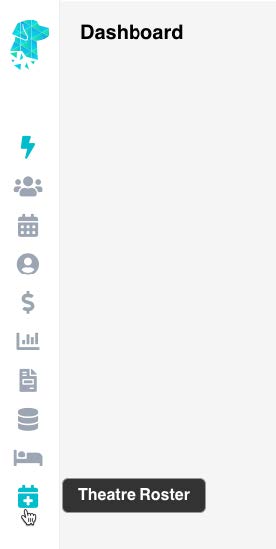
    Select Theatre Roster from the left-hand menu

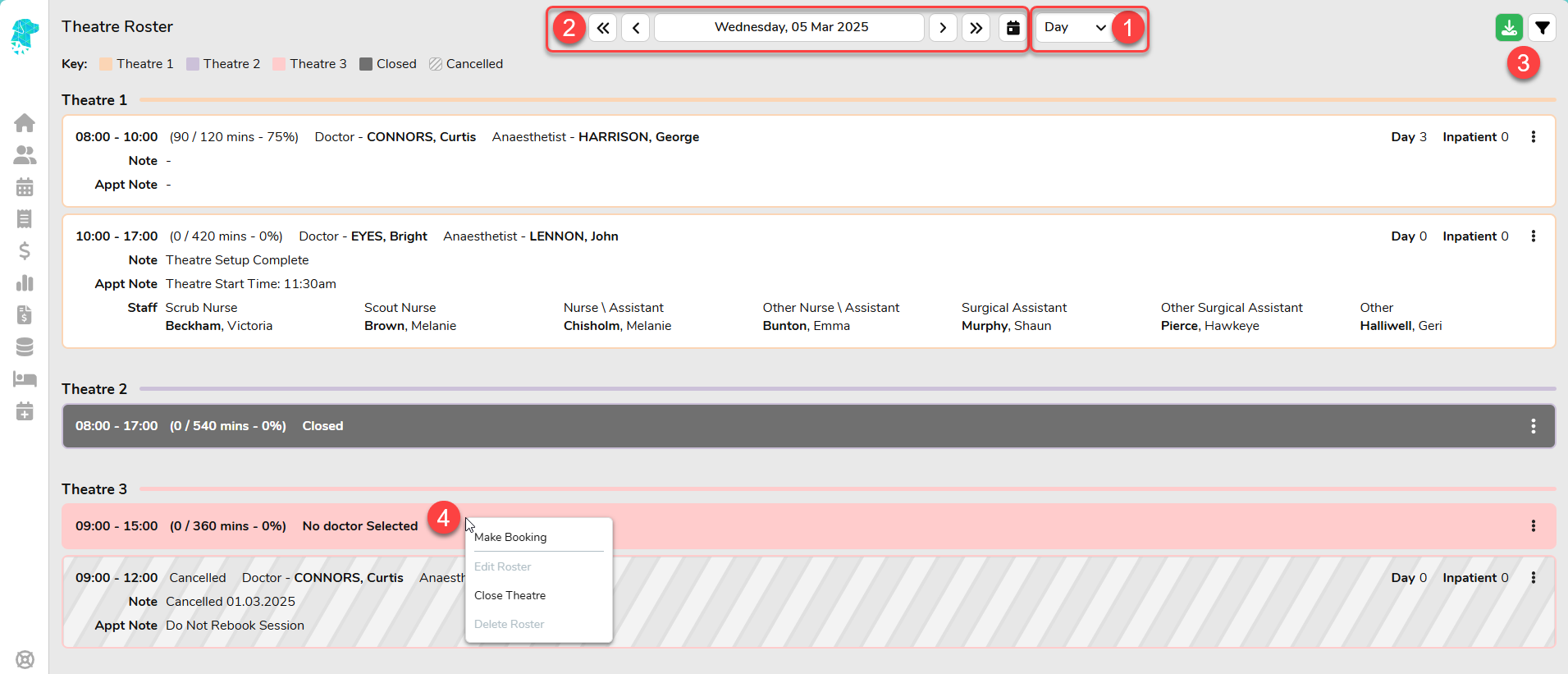
    1. Select the way you would like to view the roster:
        1. By Day
        2. By Week
        3. By Month
    2. Navigate to the date that you require using the Next and Previous arrows, Calendar or Today
    3. Utilise the Filter to customise the information on the screen
      Print allows for a screenshot of the current view to be converted to PDF for printing purposes
    4. Find the correct theatre & Right-Click to expand the options menu
    5. Select Make Booking

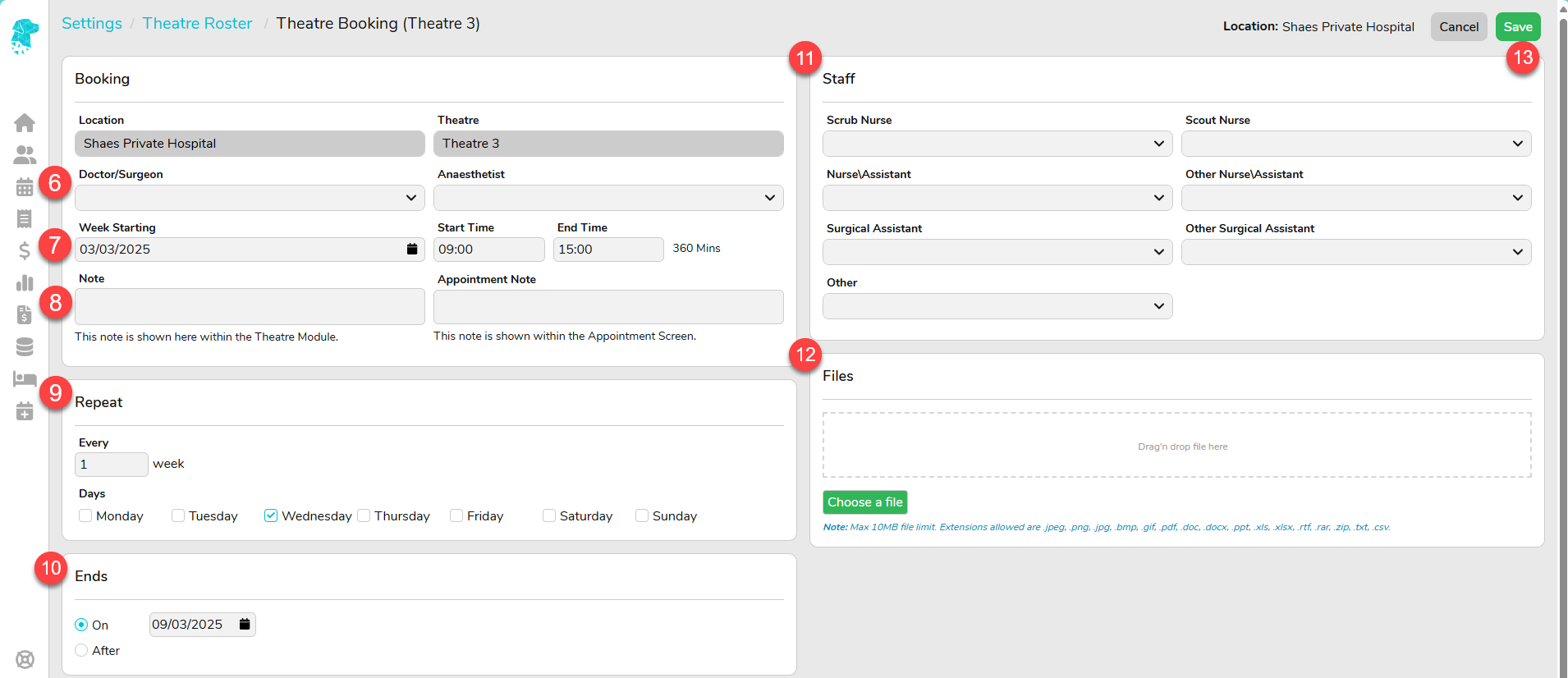
    6. Select the required Doctor/Surgeon and Anaesthetist
    7. Ensure correct Week Starting Date and Session Times are selected
    8. Notes and Appointment Notes can be added to the booking if required
    9. The Repeat feature gives the ability to produce a reoccurring booking for the selected surgeon
        1. Use the Every ____ week option to enable weekly, fortnightly, monthly bookings etc.
        2. Use the tick boxes to select the days of the week you require the booking to reoccur
    10. Use the Ends field to set the date that the reoccurring booking will cease. NB. This feature will produce an individual booking on each of the selected days for that surgeon. If this booking changes, each individual booking will need to be amended. Hence, it is not recommended to reproduce the booking for extended periods of time
    11. Add Theatre Staff (if your facility procedure requires)
    12. Import Files that are related to the Theatre Booking
    13. Click Save

    This will create a theatre booking that can then be Edited, Cancelled or Deleted with a right-click (as per #4 in the above image).
    There is a detailed Audit trail of changes made located inside the booking (right-click & Edit Roster)


    Reversing a Hospital Invoice

    For an invoice that has been incorrectly billed or needs to be reversed by way of a journal entry. Navigate to the required patient using number 1 or 2 below

    1. Select Patient tab in the left-hand menu
        1. Search for the required patient using the field in the top right
        2. Double click on required patient
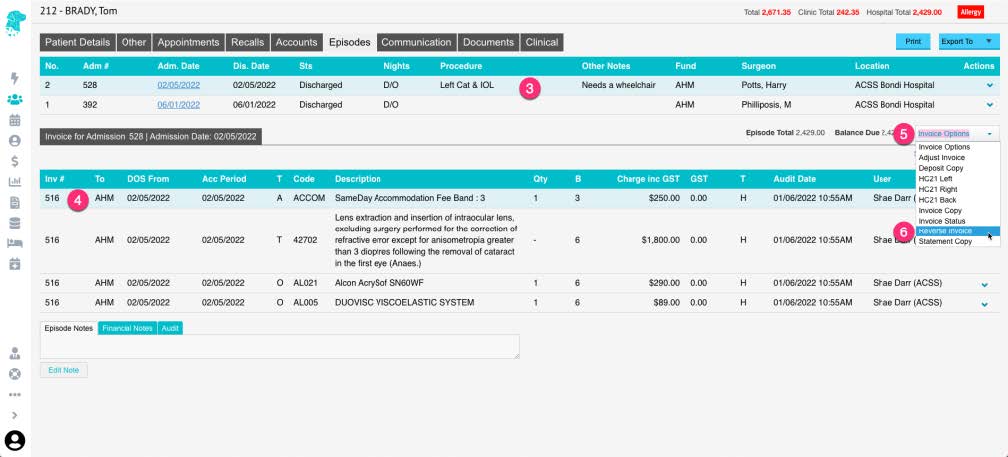
        3. Navigate to the Episodes tab across the top of the patient record
    2. Select Appointments tab in the left-hand menu
        1. Search for the required patient using the field in the centre at the top or
        2. Use the calendar to navigate to the episode date
        3. Once the patient has been located, right-click on their appointment & select History
    3. Ensure that the correct episode is selected from the list at the top
    4. Ensure that the correct invoice is selected from the information for that admission (NB this is important if there are multiple invoices for the one episode)
    5. Use the Invoice Options drop-down on the left of the screen
    6. Select Reverse Invoice

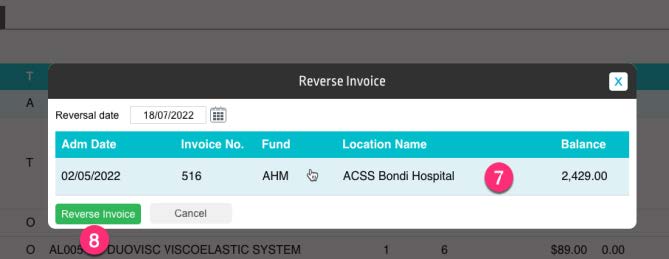
    7. The Reverse Invoice window will appear. Click on the invoice that you wish to reverse & it will turn a light shade of blue
    8. Click the Reverse Invoice option
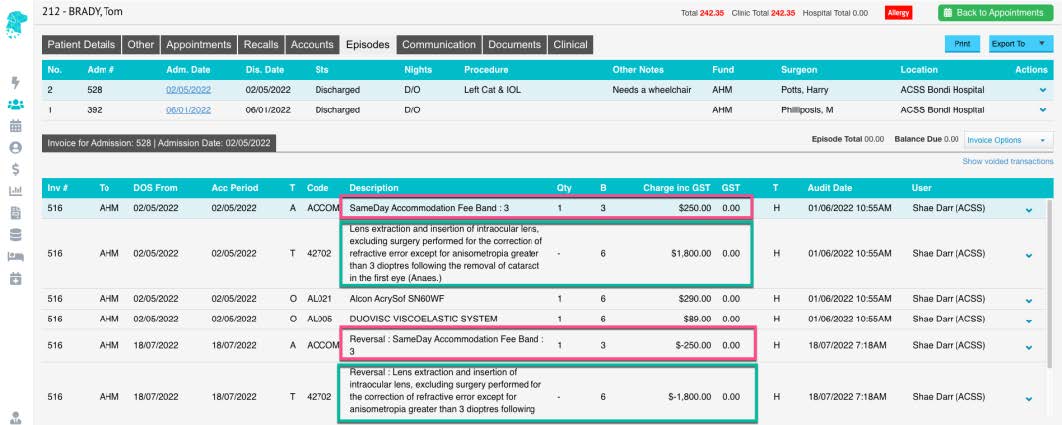
    9. The invoice will continue to show in the episode; however it will now be followed by the journal adjustments that have just been performed to revers it & zero it out


    Re-Submitting a Hospital Data Extraction

    Re-Exporting Reportable Data (PHDB/HCP/State specific)
    If you are ever required to resubmit a Data Extract, following error corrections etc, there are 2 main steps to take. Those are to reset the sent status of the episodes (instructions 1-7 below) and then to re-generate the file.

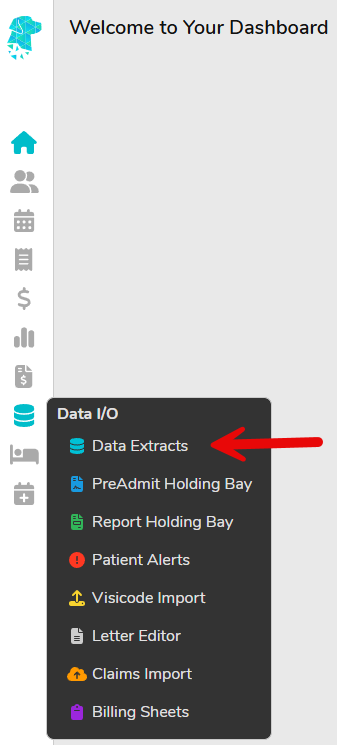
    1. Select Data I/O from the left-hand menu
    2. Select Data Extracts

    1. Ensure correct location is selected (for facilities with multiple locations)
    2. Select the month you need to re-extract
    3. Select the type of data you need to re-extract
    4. Select Resubmit Episodes

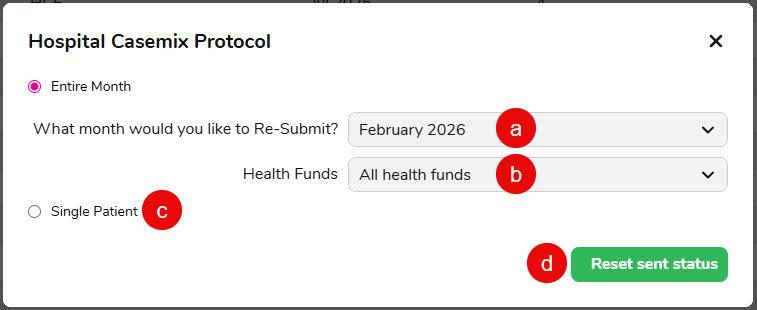
    1. In the pop-up box select:

      1. The Month you would like to re-submit.
      2. The specific health fund that you would like to re-submit
      3. Or select the Single Patient option if required (you will be prompted to search for the specific patient)
      4. Click Reset sent status

    1. In the original Data Extract screen, ensure the correct month is still selected (as per instruction number 4 above)
    2. Click Prepare Extract and in the following screen click Submit, as you would when initially submitting the Data Extract
    3. Your data files will be saved in FYDO & also in your Download folder, on your computer
    4. If needed, you can re-download this file by using the down arrow ⬇ under the Action column with a normal mouse click (not a Right Click). Once uploaded or submitted via the relevant means there is no need to keep a copy of the file on your computer, as you can access & download again if required from FYDO
    5. You can upload these files directly into the appropriate portal or send via the appropriate email address. (Ensuring the file names do not contain any symbols as this may cause an error)


    FYDO Hospital Reports

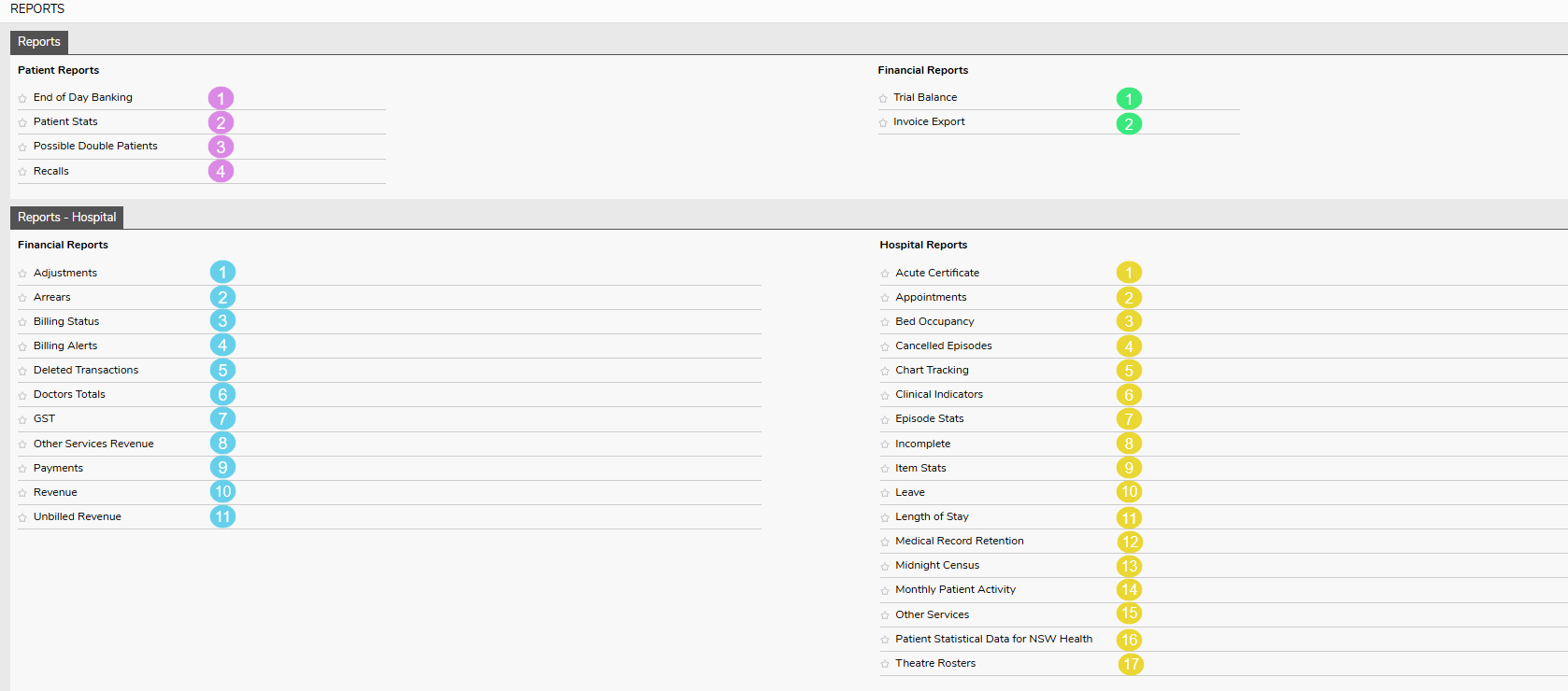
    This document gives a description of all FYDO reports & information obtainable from them. Reports can all be printed directly from FYDO or exported to PDF, Excel Spreadsheet or Raw Data (which is the most detailed option in collating data).
    Reports also gives the option to Star ★ your favourite reports. The reports that you have identified as your favourite, by clicking the star next to them, will be available on a Quick Menu that opens when you simply hover over the Reports tab in the main menu.

    For the full list of reports the user will need to click once on the Reports icon.

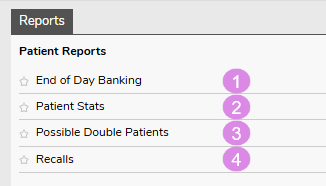
    Patient Reports

    1. End of Day Banking – Gives the ability to re-print any End of Day Banking Reports that have been previously completed. NB. To initially perform the End of Day Banking for the day go to Settings, End of Day Banking. Users are also able to reset the banking from this report, if they have made an error when initially processing the End of Day Banking.
    2. Patient Stats – Gives the ability to obtain extensive patient demographics data. Including:
      1. Medicare Eligibility Status
      2. Deceased Patients
      3. Archived Patients
      4. DVA Patients
      5. Indigenous Status
      6. Referral Expired
      7. Preferred Doctor
      8. Health Fund
      9. Gender
      10. Surveys
      11. Ability to stipulate birth date range
      12. Ability to stipulate created range
      13. Ability to stipulate post code range
    3. Possible Double Patients – Provides a list of all patients that share similar information. There are several options to base the report on, enabling easy identification of patients that have been entered into FYDO more than once.
    4. Recalls – Gives the ability to send bulk recalls to patients. Options to sort by recall date, gender, postcode etc. are all available.

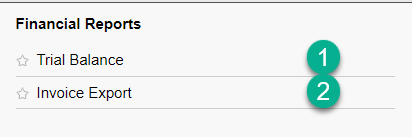
    Financial Reports

    1. Trial Balance – Shows a snapshot of the balances of all categories listed in FYDO for the date range selected.
    2. Invoice Export – Enables an Excel spreadsheet to be created of all invoices raised for the selected date range and data type.

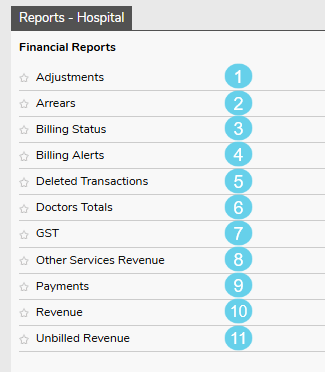
    Hospital – Financial Reports

    1. Adjustments – Shows a list of adjustments. Can be sorted by adjustment type, doctor & date range.
    2. Arrears – Shows all invoices without a zero-dollar balance. It can be run by Doctor, Fund & Period that the account has been outstanding for (e.g., 30 days & over). It can be run as:
        1. Detail – Showing every patient & the balance
        2. Summary – Showing each health fund & the balance
        3. Interactive – Enabling follow up dates & notes to be accessible, to facilitate efficient workflow in debt recovery
        4. Minimum Balance – Allowing for a dollar value to be entered & report run to show accounts over that dollar value. (Handy to exclude accounts with credits from the report)
        5. Show accounts requiring a refund only – Enables the ability to see only the accounts that are in credit, once they have been invoiced, & require a possible refund
    3. Billing Status – Details information on all episodes billed & unbilled. Reports can be run by doctor & date range & can be filtered to show:
        1. Show all – inv summary – Lists all patients that have been invoiced with a summary of charges
        2. Show all – inv detail – Lists all patients that have been invoiced, documenting each line of the invoiced charges separately
        3. Show not billed only – Is an interactive report that lists all episodes that have not been billed and allows the user to raise the invoice right from this screen! Showing details of the coding status & theatre complete status to assist with efficient workflow. Also providing a column for the Cancelled reason for users to decide if a charge needs to be raised for the episode. When ‘Show not billed only’ is selected, the user is given another option to Don’t show patients’ billed $0 if that is required, and to Exclude cancelled episodes if they wish to.
        4. Not billed in same period – Shows invoices billed in the following accounting period
    4. Deleted Transaction – Lists any transaction that has been deleted/voided from the selected period. Dates can be selected for deleted dates, accounting period or date of service.
    5. Doctors Totals – gives a detailed view of revenue generated by each doctor. There is the ability to filter by doctor, or if all doctors are selected it will show a page per doctor. Clicking on the next page arrow > will show the next doctor in alphabetical order by surname.
    6. GST Report – Allows users to obtain figures for GST on a Cash Basis or an Accrual Basis.
    7. Other Services Revenue – Lists revenue from all other services that have been billed. E.g., prosthesis, surcharges etc. Report can be filtered by doctor, fund, theatre, type or patient category. Then there is the option to obtain data based on Accounting Period or Discharge Date for the date range selected.
    8. Payments – Gives a list of all payments received in the selected date period either by Accounting Period, Audit Date or Date of Service. Filters are available by Doctor & payment type & data is able to be shown in formats such as Detailed, Summary, Audit date different to Accounting Period or Amount is negative.
    9. Revenue – Retrieves revenue information by Accounting Period or Discharge Date. Can be displayed in Detail (shows revenue totals) or Summary (showing revenue generated by each category e.g., accommodation, theatre etc). Filters can be applied to show data for a particular doctor, fund, category, theatre etc. Information can then be grouped by various means also (Health fund, Indigenous Status, Postcode etc)
    10. Unbilled Revenue – Generates a virtual invoice for all unbilled episodes, based on the item numbers entered in the theatre screen. Due to the nature of the information this report obtains, it can take a little longer to generate than other reports. It is designed to show all episodes that are not billing in real time. If the predicted item numbers are not entered in the Theatre Screen, at the time the report is run, it will be unable to calculate an accurate estimate of revenue for the episode. It will not look at dates that an invoice was billed if the “As at Date” is changed to a date prior to the current date, as it is designed to be a running tally.

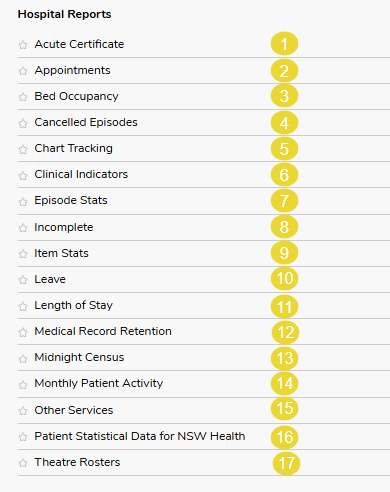
    Hospital Reports

    1. Appointments – Gives a list of all bookings, including those that are yet to be admitted.
    2. Bed Occupancy – Gives an overview of bed occupancy for the selected month. Also giving total number of beds, days, bed days available, bed days occupied & the percentage of occupancy.
    3. Cancelled Episodes – Lists all episodes that have been cancelled with their corresponding reason. It can be filtered by Cancelled Reason to obtain more specific data for the date range selected. Cancelled Reasons can also be customised (Settings > Cancelled Reasons) to assist facilities in collating the data they require.
    4. Clinical Indicators – Shows all indicators entered & the number that have been answered Yes or No during the date range selected. It can be filtered by Doctor or Theatre & is available in Summary & Detailed. Once the Detailed option is selected there are other fields that display, to ensure the exact information required is obtainable.
    5. Episode Stats – Allows for an extremely broad range of information to be obtained. There is the option to show the data in a Detailed or Summary format & can filter by a range of options. The report can be generated by Admission Date or Discharge Date. Some examples of information that can be generated from this report, for the selected period, are:
        1. All episodes
        2. Episodes for a particular Health Fund
        3. Episodes for a certain Anaesthetist
        4. Episodes for a certain Anaesthetic Type
        5. Episodes in a particular Theatre
        6. Episodes for a particular Specialty
        7. Episodes relating to a particular Booking Code
        8. Episodes for a particular Sex
        9. Indigenous Status or ATSI demographic report
        10. Age Group selection available
        11. Item numbers
        12. Diagnosis codes
        13. Procedure codes
        14. DRG’s
        15. Referring Doctor
    6. Incomplete – Gives the option to show episodes, for a selected date range, that have not been coded, have not been discharged, have not had clinical indicators entered, have not been grouped etc. It also shows the Cancelled reason to enable the user to determine if the episode requires further attention. The Uncoded Episodes and Ungrouped Episodes reports are both Interactive, meaning the coder can easily and efficiently code all episodes from one screen!
    7. Item Stats – Gives item number information for primary and subsequent procedures.
    8. Length of Stay – gives statistical data regarding the time a patient spends in certain areas of the facility. It can be filtered by several different ways & is able to give the following data for the date range selected:
        1. Pre-operative
          1. Admission Time to Time in Theatre
          2. Booking Time to Time in Theatre
          3. Booking Time to Anaesthetic Start Time
          4. Pre-Op Time to Time in Theatre
          5. Admission Time to Pre-Op Time
          6. Admission Time to Pre-Op time or Anaesthetic Start Time if pre-op time isn’t entered
        2. Intra-Operative
          1. Time in Theatre to Time out of Theatre
          2. Procedure Start Time to Procedure Finish Time
        3. Post-Operative
          1. Time out of Theatre to Discharge Time
        4. Total
          1. Admission Time to Discharge Time
          2. Admission Time to Ready for Discharge
          3. Booking Time to Discharge Time
          4. Booking Time to Ready for Discharge
        5. Comparison
          1. Planned Time in Theatre with Actual Time in Theatre
          2. Booking Length with Actual Minutes in Theatre
    9. Midnight Census – will show patients that were admitted, but not yet discharged at the “As At” date selected.
    10. Monthly Patient Activity – Gives an overview of all admissions, broken down into each day of the month. Giving the number of Total Patient Days, resulting in percentage averages for bed occupancy.
    11. Other Services – Gives a list of all the other services that have been entered into the episodes. It can be filtered by suppliers for any given date range.
    12. Patient Statistical Data for NSW Health – assists New South Wales hospitals with submitting their statistical data with ease.
    13. Theatre Rosters – shows all booked theatre sessions & all cancelled theatre sessions grouped by surgeon or theatre. Also shows theatre utilisation minutes and percentages.